Category Archives: Julia

Why I’m still a Nullable-luddite

By: Julia – Alex Mellnik

Re-posted from: http://alex.mellnik.net/why-im-still-a-nullable-luddite/

Much of my Julia work involves manipulating data in the form of DataFrames.  DataFrames are pretty handy — it’s easy to get data into them from file formats like csv and feather, as well as all types of databases.  I can split-apply-combine to my heart’s content with do blocks, and while only basic joins are possible using join, it’s easy to form more complex ones with just a few lines of code.  It’s reasonably fast to work with them, but … it could be a whole lot faster.  That’s because DataFrames, as we know them today, have columns of type DataArray, which help deal with missing values.  A DataArray of some type T has elements which are either of type T, or if the element is missing, of type NAType.  This type instability means that the Julia JIT can’t easily determine the type of the elements, which is a big performance killer.1

This is all old news, and everyone agrees that that we need to move toward a better solution: Nullables.  Rather than encoding your possibly-missing values in a a DataArray, you can make a normal Array of type Nullable{T}.2  This has the advantage that when you access elements of Array you always get the same type, and the JIT is happy. 3

Sounds grand, right?  This is the reason that many packages that work with DataFrames have started moving from DataArrays to normal arrays of Nullables.  Unfortunately, it turns out that Nullables are a pain to work with, and because of this I generally take the performance hit and convert everything back to DataArrays.  How much of a pain are they to work with?  Here’s a list of some fairly reasonable things that you can’t do with Nullables (on 0.4.5):

 # Needs to be get(Nullable(1)) + get(Nullable(2))
Nullable(1) + Nullable(2)
 # You can't add arrays of Nullables to containers.
df = DataFrame()
df[:col] = NullableArray([1,2])
# This returns false, although it may be fixed soon. 
Nullable(0, true) !== Nullable{Int}()

Most importantly, Nullable(T) is a vastly different creature than T.  You can’t take it bowling and buy it a beer: any time you want to hand it off to pretty much any package you need to convert it back to the original type to have it function as expected.

Because of these issues, I’m planning on sticking with DataArrays until the Nullable ecosystem is in a more mature state.  I have high hopes that this will coincide with the release of 0.5.0, but others are not as optimistic.  We’ll see!  Despite these growing pains, it’s a very exciting time to work in Julia.


  1. John Myles White has a nice post about this here.
  2. There’s also NullableArrays.jl which cleans things up a bit, but most of the issues I discuss below hold regardless.
  3. There’s still some lingering performance issues related to the DataFrame container.

Using Julia on the web

By: Julia – Alex Mellnik

Re-posted from: http://alex.mellnik.net/using-julia-to-perform-calculations-on-a-web-site/

A fairly common problem is that you want to use Julia or another high level language to solve a problem, but also provide that solution to the world through a web site.  For Julia, you have a few different options:

  • Use Escher.jl.  This is a full-stack web server here pages are written in Julia.  It can do a lot of interesting things and is good for simple demos.  However, it is still in an early state, doesn’t play nicely with the existing web ecosystem, and has some performance issues.
  • Write the server-side code from scratch in Mux.jl.  This offers a lot more flexibility than Escher.jl, and could be used as a back-end along with static front end that uses your favorite tools.  However, it could lead to some extra overhead, especially if you already have server-side components.
  • Run an API from JuliaBox.  This is still somewhat experimental.
  • Use node-julia to call Julia directly from Node.js.  If you’re already using node, this seems like the best option at the moment.

Node-julia can be tricky to install and its syntax can seem arcane, but once you’re familiar with passing data back and forth between Javascript and Julia you can call your Julia code with minimal effort.  This winter I threw together a simple example here — index.js might look a bit complicated, but most of the code deals with handling an uploaded csv file.

Some remarks about min()/max() functions

By: Picaud Vincent

Re-posted from: https://pixorblog.wordpress.com/2016/06/27/some-remarks-about-minmax-functions/

Computing the min (or max) of two values looks like a trivial task.

For C++ the default Standard Template Library implementation is

inline const _Tp& min(const _Tp& __a, const _Tp& __b)
{
    return __b < __a ? __b : __a;
}

However for numerical computations this definition does not mix well with the IEEE 754 standard when dealing with potential NaN value.

For instance, min() is not commutative and is not equivatent to cmath::fmin().

We have:

#include <iostream>
#include <cmath>
#include <limits>
#include <cassert>

using namespace std;

int main()
{
    const auto x_nan = numeric_limits<double>::quiet_NaN();
    const auto x_1 = 1.;

    cout << boolalpha;

    cout << "\n\ncommutativity?";

    cout << "\n min: "
     << (min(x_1, x_nan) == min(x_nan, x_1));

    cout << "\nfmin: "
     << (fmin(x_1, x_nan) == fmin(x_nan, x_1));
}
commutativity?
 min: false
fmin: true

The IEEE 754 says:

In section 6.2 of the revised IEEE 754-2008 standard there are two anomalous functions (the maxnum and minnum functions that return the maximum of two operands that are expected to be numbers) that favor numbers — if just one of the operands is a NaN then the value of the other operand is returned.

On the opposite you can read about C++ rules here:

NaN values have the curious property that they compare as “unordered” with all values, even with themselves. In other words, if x is a NaN, and y is any floating-point value, NaN or not, then x<y, x>y, x<=y, x>=y, and x==y are all false, and x!=y is true.

Remark In C/C++ that is the reason why you can implement the isnan function by

bool isnan(const double x) { return x!=x;}

Using min/max in numerical code

C++

Like the IEEE 754 and C++ standard do not mix well, I personally redefine min()/max() functions as follow:

#include <type_traits>
#include <cmath>

namespace libraryNamespace
{
    template <typename T>
    inline enable_if_t<is_floating_point<T>::value, T>
      min(const T& t1, const T& t2)
    {
        return fmin(t1, t2);
    }

    template <typename T>
    constexpr enable_if_t<is_integral<T>::value, const T&>
      min(const T& t1, const T& t2)
    {
        return (t1 < t2) ? t1 : t2;
    }
    // max() function follows the same scheme
}

Julia

Julia follows the scheme I use in C++, you have a specialization for floating point numbers julia/base/math.jl

min{T<:AbstractFloat}(x::T, y::T) =
    ifelse((y < x) | (signbit(y) > signbit(x)),
           ifelse(isnan(y), x, y), ifelse(isnan(x), y, x))

and a generic operator julia/base/operator.jl

min(x,y) = ifelse(y < x, y, x)

We can check that the Float specialization follows the IEEE 754 rule:

(max(5,NaN)==max(NaN,5))&&(max(5,NaN)==5)
true

What is the cost?

Julia

There is a big difference between the simple definition in julia/base/operator.jl and the NaN aware code of julia/base/math.jl.

We can have a look at the assembly code.

I would like to thank Erik Schnetter who made me noticed that Julia 4.6 @code_native was bugged (see his comment at the end of this post). Hence to get the same result you must have a recent Julia version. In this post I use:

versioninfo()
Julia Version 0.5.0-dev+5453
Commit 1fd440e (2016-07-15 23:33 UTC)
Platform Info:
  System: Linux (x86_64-linux-gnu)
  CPU: Intel(R) Core(TM) i3 CPU       M 380  @ 2.53GHz
  WORD_SIZE: 64
  BLAS: libopenblas (USE64BITINT DYNAMIC_ARCH NO_AFFINITY Nehalem)
  LAPACK: libopenblas64_
  LIBM: libopenlibm
  LLVM: libLLVM-3.7.1 (ORCJIT, westmere)

With this Julia version you get the following asm codes:

@code_native(min(1,2))

gives

	.text
Filename: promotion.jl
	pushq	%rbp
	movq	%rsp, %rbp
Source line: 257
	cmpq	%rdi, %rsi
	cmovgeq	%rdi, %rsi
	movq	%rsi, %rax
	popq	%rbp
	retq

whereas

@code_native min(1.0,2.0)

gives

	.text
Filename: math.jl
	pushq	%rbp
	movq	%rsp, %rbp
Source line: 203
	ucomisd	%xmm1, %xmm0
	seta	%al
	movmskpd	%xmm1, %ecx
	movmskpd	%xmm0, %edx
	andl	$1, %edx
	xorb	$1, %dl
	andb	%cl, %dl
	orb	%al, %dl
	je	L54
	movapd	%xmm1, %xmm2
	cmpordsd	%xmm2, %xmm2
	andpd	%xmm2, %xmm1
	andnpd	%xmm0, %xmm2
	orpd	%xmm1, %xmm2
	jmp	L75
L54:
	movapd	%xmm0, %xmm2
	cmpordsd	%xmm2, %xmm2
	andpd	%xmm2, %xmm0
	andnpd	%xmm1, %xmm2
	orpd	%xmm0, %xmm2
L75:
	movapd	%xmm2, %xmm0
	popq	%rbp
	retq
	nopw	%cs:(%rax,%rax)

C++

We have the same in C++

#include <cmath>
#include <iostream>

int main()
{
  double x, y;
  std::cin >> x >> y;
  asm("#ASM FOR FMIN");
  double fmin_x_y = std::fmin(x, y);
  asm("#ASM FOR FMIN - END");
  std::cout << "\n" << fmin_x_y;

  asm("#ASM FOR MIN");
  double min_x_y = std::min(x, y);
  asm("#ASM FOR MIN - END");
  std::cout << "\n" << min_x_y;
  return 0;
}

compiled with

g++ -std=c++11 -O3 -S min.cpp -o min.asm

gives for min()

#ASM FOR MIN
	movsd	24(%rsp), %xmm0
	minsd	16(%rsp), %xmm0
	movsd	%xmm0, 8(%rsp)
#ASM FOR MIN - END

and for fmin()

#ASM FOR FMIN
	movsd	24(%rsp), %xmm1
	movsd	16(%rsp), %xmm0
	call	fmin
	movsd	%xmm0, 8(%rsp)
#ASM FOR FMIN - END

CPU time?

Illustration with the Jaccard distance defined by

d_J(x,y)=1-\frac{\sum\limits_i \min(x_i,y_i)}{\sum\limits_i \max(x_i,y_i)},\ \text{where}\ (x,y)\in\mathbb{R}_+^n\times\mathbb{R}_+^n

We compute this distance using 4 different approaches:

  • Julia min()/max() NaN aware
  • Julia min()/max() comparison
  • C fmin()/fmax() NaN aware
  • C min()/max() comparison

The Julia code is given below

function jaccard_julia_NaN_aware(a::Array{Float64,1},
                                 b::Array{Float64,1})

    @assert length(a)==length(b) 

    num::Float64 = 0
    den::Float64 = 0

    for i in 1:length(a)

        @inbounds num += min(a[i],b[i])
        @inbounds den += max(a[i],b[i])

    end
    return 1. - num/den
end

function jaccard_julia_comparison(a::Array{Float64,1},
                                  b::Array{Float64,1})

    @assert length(a)==length(b) 

    num::Float64 = 0
    den::Float64 = 0

    for i in 1:length(a)

        @inbounds num += ifelse(a[i]<b[i],a[i],b[i])
        @inbounds den += ifelse(a[i]>b[i],a[i],b[i])

    end
    return 1. - num/den
end

function jaccard_C_NaN_aware(a::Array{Float64,1},
                             b::Array{Float64,1})

    @assert length(a)==length(b) 

    return ccall((:jaccard_C_NaN_aware,
                  "./libjaccard.so"),
                 Float64,
                 (Int64,Ptr{Float64},Ptr{Float64}),
                 length(a),a,b)

end

function jaccard_C_comparison(a::Array{Float64,1},
                              b::Array{Float64,1})

    @assert length(a)==length(b) 

    return ccall((:jaccard_C_comparison,
                  "./libjaccard.so"),
                 Float64,
                 (Int64,Ptr{Float64},Ptr{Float64}),
                 length(a),a,b)

end

function test_distance(f,
                       v1::Array{Float64,1},
                       v2::Array{Float64,1})
    sum=0
    for i in 1:5000
        sum+=f(v1,v2)
    end
    sum
end

v1=rand(10000);
v2=rand(10000);

for name in (:jaccard_julia_NaN_aware,
             :jaccard_C_NaN_aware,
             :jaccard_julia_comparison,
             :jaccard_C_comparison)
    print("$name")
    @time @eval test_distance($name,v1,v2)
end

The associated C subroutines are:

#include <math.h>
#include <stdint.h>

double jaccard_C_NaN_aware(uint64_t size,
               double *a, double *b)
{
  double num = 0, den = 0;

  for(uint64_t i = 0; i < size; ++i)
    {
      num += fmin(a[i],b[i]);
      den += fmax(a[i],b[i]);
    }
  return 1. - num / den;
}

double jaccard_C_comparison(uint64_t size,
                double *a, double *b)
{
  double num = 0, den = 0;

  for(uint64_t i = 0; i < size; ++i)
    {
      num += (a[i] < b[i] ? a[i] : b[i]);
      den += (a[i] > b[i] ? a[i] : b[i]);
    }
  return 1. - num / den;
}

and the Makefile is

all: bench

bench: libjaccard.so
    @julia --optimize --check-bounds=no jaccard.jl

libjaccard.so: jaccard.c
    @gcc -O2 -shared -fPIC jaccard.c -o libjaccard.so

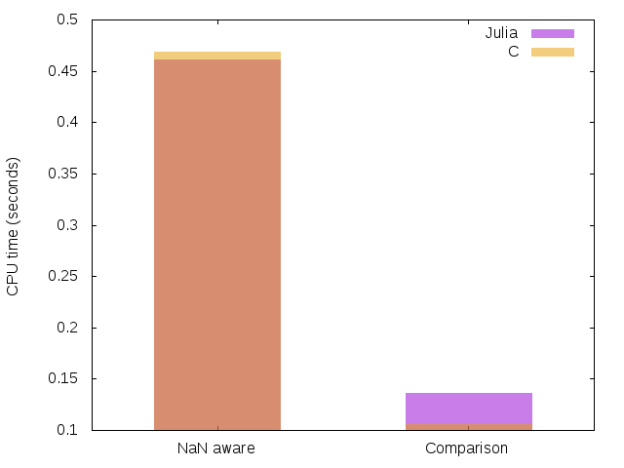
The results I get on my computer are:

make

output.png

We see that:

  • for the NaN aware case C and Julia running time is equivalent, great!
  • for the Comparison case C seems to be a little bit faster, but the gap is very small and more precise benchmark would be necessary to quantify it.
  • min()/max() using simple comparisons is more than 3.5 times faster than an implementation taking into account possible NaN values.

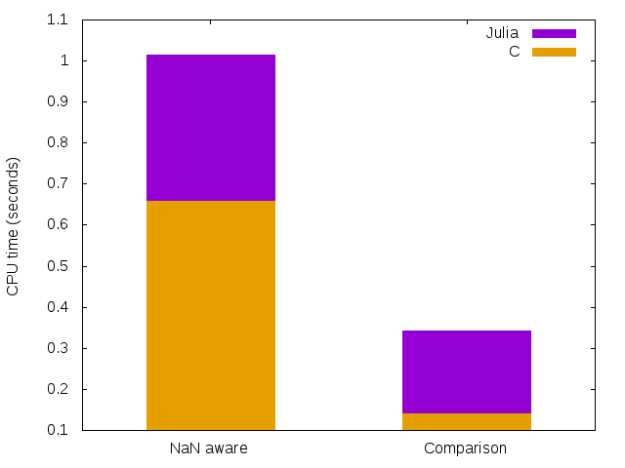
Julia 4.6 previous results

In the first version of this post, using julia version 4.6, I got this result:

output_4_6.png

There was a clear advantage for the C code, but it seems this is not the case anymore with julia version 0.5.

You can reproduce the results of this post, using the code available on GitHub.

A source of bugs?

You have to take care that a simple statement like

x\le\min(x,y)

is mathematically true but false in your code. It is even false for both the IEEE 754 and the comparison based versions of the min() function.

In the future I will write a post on Automatic Differentiation. To be brief automatic differentiation is a tool that allows you to efficiently compute gradient with nearly no modification of your original code. As example my personal implementation takes the form:

// Declare the current tape
//
AD_Tape<double> tape;

// Computes gradient of f(x,y,z)=x.z.sin(x.y)
//                   at (x,y,z)=(2,1,5)
//
// Note:
//
// grad(f)={ x * y * z * Cos(x * y) + z * Sin(x * y),
//           x^2 * z *
//           Cos(x * y), x * Sin(x * y) }
//
AD_Scalar<double> x, y, z, f;

x = 2;
y = 1;
z = 5;

f = x * z * sin(x * y);

const auto grad = ad_gradient(f);

std::cout << "\ngrad(f) = {"
          << grad[x] << "," 
          << grad[y] << ","
          << grad[z] << "}";

// The screen output is
//
// grad(f) = {0.385019,-8.32294,1.81859}

One classical approach uses operator overloading. For each basic operation you compute the function value and its differential.

One important and desirable property of AutoDiff library is that its use does not modify your program result.

Unfortunately a lot of AutoDiff libraries are bugged when they define the min()/max() functions.

It is really “natural” to define min() overloading by something like:

function min(x,y)
    ifelse(x<y,
           return (x,dx),
           return (y,dy))

But this implementation is buggy: if y is NaN we now know that x<y is always false, hence:

  • the original code will return x
  • the AutoDiff code will return (y,dy) (a priori =(NaN,NaN))

To stay consistent the correct implementation is something like:

function min(x,y)
    ifelse(x==min(x,y),
           return (x,dx),
           return (y,dy))

which provides the right result (id consistent with the original code) whatever x or y is NaN or not

We can check that, for instance, with Julia ForwardDiff.jl

(githash: 045a828)

using ForwardDiff
f(x::Vector)=max(2*x[1],x[2]);
x=[1.,NaN]
print("Original value: $(f(x))")
print("\nAutoDiff gradient: $(ForwardDiff.gradient(f, x))")
Original value: 2.0
AutoDiff gradient: [0.0,1.0]

which is wrong, in this case the right gradient is

\nabla [(x_1,x_2)\rightarrow max(2.x_1,x_2)]_{x_1=1,x_2=NaN}=(2,0)

Final word

  • Concerning min()/max() examples of this post I have observed a big performance gain in using Julia version 5.0. What is not clear is the reason of this gain:

    • I compiled my own version of Julia 5.0, but I used the 4.6 version shipped with Debian. Maybe my compiled version uses some different compiler flags (like -march=native…).
    • or there is a real improvement between version 4.6 -> 5.0

    You can reproduce the benchmark using the code available on GitHub. Any feed back is welcome.

  • The @native_code macro of Julia version 4.6 seems to be bugged.
  • It is “easy” to introduce bugs when you mix comparison operators and IEEE 754 min()/max() functions. Implementing min()/max() in a Automatic Differentiation framework is one perfect illustration of this and was the point that motivated me to write this post.
  • (Joke) If you are fed up with min()/max() you can use absolute value:

min(x,y)=\frac{1}{2}(|x+y|-|x-y|)

max(x,y)=\frac{1}{2}(|x+y|+|x-y|)

… but these relations do not follow the IEEE 754 standard!

I would like to thank my colleague JP. Both for having noticed that min()/max() was “abnormally” slow (Julia 4.6), Y. Borstein for some emails exchanges concerning min()/max() in Julia (before I wrote this post), Erik Schnetter who told me to switch to a more recent Julia version.