By: OpenSourcES
Re-posted from: https://opensourc.es/blog/2016-04-18-memory-palace/index.html
Learn something in a different way, using your own memory palace.
Read more
By: OpenSourcES
Re-posted from: https://opensourc.es/blog/2016-04-18-memory-palace/index.html
Learn something in a different way, using your own memory palace.
Read more
Re-posted from: http://www.stochasticlifestyle.com/236-2/
How many workers do you choose when running a parallel job in Julia? The answer is easy right? The number of physical cores. We always default to that number. For my Core i7 4770K, that means it’s 4, not 8 since that would include the hyperthreads. On my FX8350, there are 8 cores, but only 4 floating-point units (FPUs) which do the math, so in mathematical projects, I should use 4, right? I want to demonstrate that it’s not that simple.
Most of the time when doing scientific computing you are doing parallel programming without even knowing it. This is because a lot of vectorized operations are “implicitly paralleled”, meaning that they are multi-threaded behind the scenes to make everything faster. In other languages like Python, MATLAB, and R, this is also the case. Fire up MATLAB and run
A = randn(10000,10000)
B = randn(10000,10000)
A.*B
and you will see that all of your cores are used. Threads are a recent introduction to Julia, and so in version 0.5 this will also be the case.
Another large place where implicit parallelization comes up is in linear algebra. When one uses a matrix multiplication, it is almost surely calling an underlying program which is an implementation of BLAS. BLAS (Basic Linear Algebra Subroutines) is aptly named just a set of functions for solving linear algebra problems. These are written in either C or Fortran and are heavily optimized. They are well-studied and many smart people have meticulously crafted “perfect code” which minimizes cache misses and all of that other low level stuff, all to make this very common operation run smoothly.
Because BLAS (and LINPACK, Linear Algebra Package, for other linear algebra routines) is so optimized, people say you should always make sure that it knows exactly how many “real” processors it has to work with. So in my case, with a Core i7 with 4 physical cores and 4 from hyperthreading, forget the hyperthreading and thus there are 4. With the FX8350, there are only 4 processors for doing math, so 4 threads. Check to make sure this is best.
Most likely this does not apply to your code. You didn’t carefully manage all of your allocations and tell the compiler what needs to be cached etc. You just wrote some beautiful Julia code. So how many workers do you choose?
Let’s take my case. I have 4 real cores, do I choose 4? Or do I make 3 workers to allow for 1 to “command” the others freely? Or do I make 7/8 due to hyperthreading?
I decided to test this out on a non-trivial example. I am not going to share all of the code (I am submitting it as part of a manuscript soon), but the basic idea is that it is a high-order adaptive solver for stochastic differential equations. The code sets up the problem and then calls pmap to do a Monte Carlo simulation and solve the equation 1000 times in parallel. The code is mostly math, but there is a slight twist where some values are stored on stacks (very lightweight datastructure). To make sure I could trust the times, I ran the code 1000 times and took the average, min, and max times.
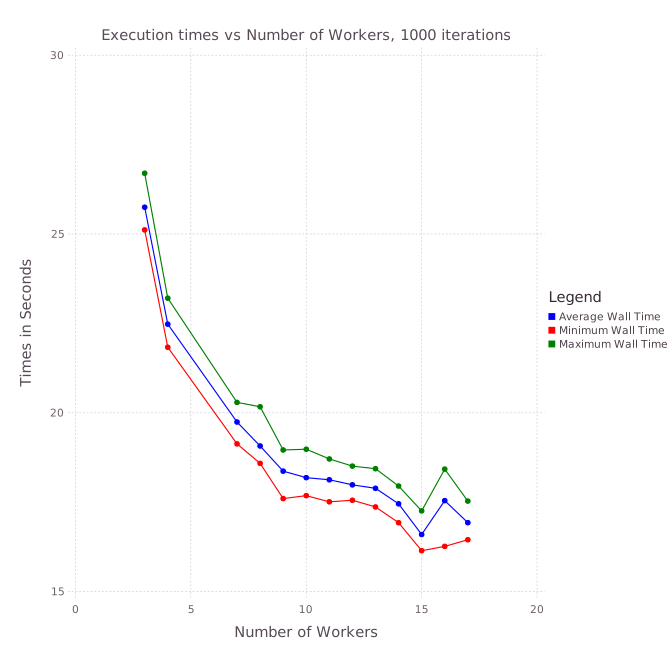
So in this case, what was best? The results speak for themselves.
| Number of Workers | Average Wall Time | Max Wall Time | Min Wall Time |
|---|---|---|---|
| 1 | 62.8732 | 64.3445 | 61.4971 |
| 3 | 25.749 | 26.6989 | 25.1143 |
| 4 | 22.4782 | 23.2046 | 21.8322 |
| 7 | 19.7411 | 20.2904 | 19.1305 |
| 8 | 19.0709 | 20.1682 | 18.5846 |
| 9 | 18.3677 | 18.9592 | 17.6 |
| 10 | 18.1857 | 18.9801 | 17.6823 |
| 11 | 18.1267 | 18.7089 | 17.5099 |
| 12 | 17.9848 | 18.5083 | 17.5529 |
| 13 | 17.8873 | 18.4358 | 17.3664 |
| 14 | 17.4543 | 17.9513 | 16.9258 |
| 15 | 16.5952 | 17.2566 | 16.1435 |
| 16 | 17.5426 | 18.4232 | 16.2633 |
| 17 | 16.927 | 17.5298 | 16.4492 |
Note there are two “1000”s here. I ran the Monte Carlo simulation (each solving the SDE 1000 times itself) 1000 times. I plotted the mean, max, and min times it took to solve the simulation. From the plot it’s very clear that the minimum exists somewhere around 15. 15!
What’s going on? My guess is that this is because of the time that’s not spent on the actual mathematics. Sometimes there are things performing logic, checking if statements, allocating new memory as the stacks grow bigger, etc. Although it is a math problem, there is more than just the math in this problem! Thus it seems the scheduler is able to effectively let the processes compete and more fully utilize the CPU by pushing the jobs around. This can only go so far: if you have too many workers, then you start to get cache misses and then the computational time starts to increase. Indeed, at 10 workers I could already see signs of problems in the resource manager.

Overload at 10 Workers as seen in Window’s Resource Manager
However, allowing one process to start re-allocating memory but causing a cache miss (or whatever it’s doing) seems to be a good tradeoff at low levels. Thus for this code the optimal number of workers is far above the number of physical cores.
The moral is, test your code. If your code is REALLY efficient, then sure, making sure you don’t mess with your perfect code is optimal. If your code isn’t optimal (i.e. it’s just some Julia code that is pretty good and you want to parallelize it), try some higher numbers of workers. You may be shocked what happens. In this case, the compute time dropped more than 30% by overloading the number of workers.
The post Optimal Number of Workers for Parallel Julia appeared first on Stochastic Lifestyle.
By: Julia Developers
Re-posted from: http://feedproxy.google.com/~r/JuliaLang/~3/g79rtt9xfcw/gsoc
We’re pleased to announce that the Julia Language is taking part in this year’s Google Summer of Code. This means that interested students will have the opportunity to spend their summers getting paid to write code on a project of their choice.
Student applications are open from March 14th – 25th on the SoC website, but there’s no reason not to get going right away! To get you started thinking about what you’d like to work on, there are a bunch of interesting projects on our ideas page. At this stage, it’s also a good idea to start getting involved with the community around your area of interest by opening issues, sending PRs and speaking to developers on relevant packages. Finding a good mentor for your project will be a big help for most applications, and showing mentors your enthusiasm is a great way to get them on board. Once you’re ready to start writing an application, check out our guidelines which gives some hints on what to include.
To give an idea of the kind of projects we’d like to support:
We welcome involvement in our summer frivolities even if you’re not a student. Firstly, if you happen to know any students, please let them know! We’d also like to encourage people to step up as mentors, so if you’re interested then please contact us (see below) and let us know what areas you’d like to help with. Please also feel free to give technical feedback on proposals that come up on our mailing lists.
The primary point of contact for the community is our mailing list, [email protected]. For more administrative questions you can also reach out to us privately at [email protected]. Feel free to start discussions about projects and ideas, although note that it’s easier for us to answer broad questions about the process than to give specific technical feedback.
Our participation in previous years has resulted in some great projects, so we’re really looking forward to working with you this year and seeing what you can do. Good luck!