By: Chad Scherrer
Re-posted from: https://informativeprior.com/blog/2022/03-21-tilde/index.html
We introduce Tilde, a new probabilistic programming language and successor to Soss.
By: Chad Scherrer
Re-posted from: https://informativeprior.com/blog/2022/03-21-tilde/index.html
We introduce Tilde, a new probabilistic programming language and successor to Soss.
By: Dean Markwick's Blog -- Julia
Re-posted from: https://dm13450.github.io/2022/03/22/AlpacaMarkets.jl-More-Free-Data.html
My quest for free and accessible data continues. This time turning to
https://alpaca.markets/. They provide both stock and crypto trades
and quotes with the ability to easily backload a database.
Enjoy these types of posts? Then sign up for my newsletter.
I’m no stranger to writing API wrappers in Julia for various data
sources, I revitalised
AlphaVantage.jl
and also behind CoinbasePro.jl, each providing a slightly different
type of data. The same is now for Alpaca Markets data. AlphaVantage
only provides candle data for stocks, whereas Alpaca gives you both
quotes and trades. This gives a new angle to look at the markets with
much more granular data. Likewise, with CoinbasePro.jl, it is good for providing real-time data, but when you try and get historical data it is limited. Alpaca removes these limits and lets you backfill as much as needed. It might take some time but gives your laptop to do something while you sleep.
Their data is from IEX (of Flash Boys fame). They provide the both the
quote and trade data free from their website
https://exchange.iex.io/products/market-data-connectivity/, so this
AlpacaMarkets.jl acts
as an easy wrapper around this data through Alpaca. Plus if Alpaca ever
add more sources you will get this without too much trouble as well.
I’ve written exact wrappers to their exposed functions, but also added some functions that will help you get the data you need without worrying about formatting timestamps or managing pagination responses.
To get started with the API you’ll need to sign up to AlpacaMarkets and get some API keys.
You need to sign up to Alpaca markets to obtain your developer keys to connect to their services. Once you have both the key and the secret you need to authenticate AlpacaMarkets.jl.
You can do this manually, using:
using AlpacaMarkets
AlpacaMarkets.auth(KEY, SECRET)
Where KEY and SECRET are the two values personal to you.
Or you can make sure you are always authenticated by including the keys in your startup.jl file in .julia/config/.
ENV["ALPACA_KEY"] = KEY
ENV["ALPACA_SECRET"] = SECRET
Once this is done you should all be good to go!
Now we are set up, we can get going with pulling some data. A few packages are needed to make our lives easier. Most importantly, AlpacaMarkets.jl.
using AlpacaMarkets
using Dates, DataFrames, DataFramesMeta
using Statistics
using Plots
using TimesDates
A quote is a price you could buy or sell a stock for. Across the US equity landscape, there are different exchanges where you could trade a stock, so at any given time there is one place that offers the best price to buy and sell a stock.
If we look at just 1 second’s worth of quotes we get quite a bit of data back.
aapl = AlpacaMarkets.get_stock_quotes("AAPL",
  DateTime("2022-01-27T15:00:00"),
  DateTime("2022-01-27T15:00:01"))
first(aapl, 3)
3 rows × 10 columns (omitted printing of 2 columns)
| ap | as | ax | bp | bs | bx | c | t | |
|---|---|---|---|---|---|---|---|---|
| Float64 | Int64 | String | Float64 | Int64 | String | Any | String | |
| 1 | 163.08 | 2 | Q | 163.06 | 1 | P | R | 2022-01-27T15:00:00.007177Z |
| 2 | 163.08 | 2 | Q | 163.05 | 4 | Q | R | 2022-01-27T15:00:00.007566848Z |
| 3 | 163.08 | 2 | K | 163.05 | 4 | Q | R | 2022-01-27T15:00:00.010519578Z |
In the ax and bx columns (ask exchange and bid exchange) we can see what venue was offering that price at a given time. More on that later.
If we want to look at this data we have to convert the timestamp into a Julia DateTime object. The values that come down the wire are a little funky, so I’ve written a help function in the AlpacaMarkets.jl module to help.
function convert_t_timestamp(x)
   ts =  first(x, 23)

    if endswith(ts, "Z")
        ts = chop(ts)
    end
    DateTime(ts)
end

function convert_t_time(x)
   ts = split(x, "T")[2]
   ts = first(ts, 12)
    if endswith(ts, "Z")
        ts = chop(ts)
    end
    Time(ts)
end
However, Julia’s default DateTime type only allows up millisecond precision. When we look at our data we have up to nanoseconds, so need to use the TimeDate.jl package to account for these extra digits.
aapl = @transform(aapl, :TimeStamp = convert_t_timestamp.(:t),
                        :TimeStamp_nano = TimeDate.(string.(chop.(:t))));
We now plot the bid and ask price.
ticks = minimum(aapl.TimeStamp):Millisecond(250):maximum(aapl.TimeStamp)
tick_labels = Dates.format.(ticks, "HH:MM:SS.sss")

plot(aapl.TimeStamp, aapl.ap, label = "Ask Price", seriestype=:steppre, xticks = (ticks, tick_labels))
plot!(aapl.TimeStamp, aapl.bp, label = "Bid Price", seriestype=:steppre)
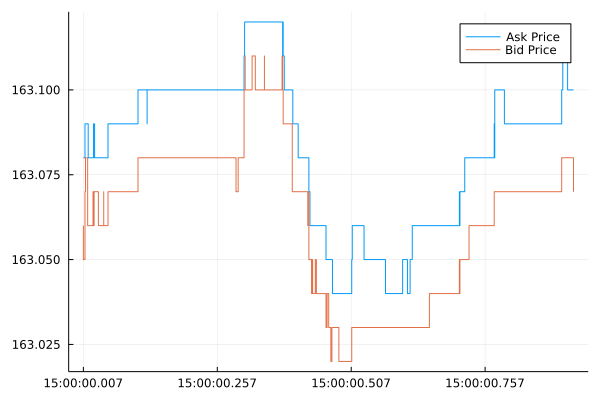
There we go, the movement of the best bid and ask price over one
second. Most data sources would condense this into a single open-high-low-close bar, whereas AlpacaMarkets.jl is giving us the raw data underneath that data. All for free!
This means you can now calculate things like:
I’ve written about
Order flow imbalance
before in the crypto markets. It is about looking at frequent changes
in the best ask/offer and the amount that corresponds to these prices. Each small change gives us an idea of the supply and demand and can reasonably predict future price movements.
Overall, getting the raw best bid/offers from Alpaca across all these stocks is a treasure trove of information, and using my package you can easily save a database worth of data for your project.
Alpaca Markets also give us access to what trades, so stock
transactions, that happened over some time. This records how much stock was traded at a given time and for what price.
Again we will look at the same one-second period.
aaplTrades  = AlpacaMarkets.get_stock_trades("AAPL", DateTime("2022-01-27T15:00:00"), DateTime("2022-01-27T15:00:01"))
first(aaplTrades, 5)
5 rows × 8 columns
| c | i | p | s | t | x | z | symbol | |
|---|---|---|---|---|---|---|---|---|
| Any | Int64 | Float64 | Int64 | String | String | String | String | |
| 1 | @ | 39300 | 163.07 | 25 | 2022-01-27T15:00:00.010519578Z | Q | C | AAPL |
| 2 | I | 39300 | 163.07 | 25 | 2022-01-27T15:00:00.010519578Z | Q | C | AAPL |
| 3 | @ | 39301 | 163.08 | 100 | 2022-01-27T15:00:00.010519578Z | Q | C | AAPL |
| 4 | @ | 39302 | 163.08 | 100 | 2022-01-27T15:00:00.010519578Z | Q | C | AAPL |
| 5 | @ | 7109 | 163.08 | 100 | 2022-01-27T15:00:00.010711251Z | U | C | AAPL |
We can see a new column, c which has different symbols for each row. This is the condition code and describes the type of trade. For the first two trades we see:
@ : Is a regular tradeI: is an odd lot tradeThe x column dictates where the trade happened, so the venue that executed the trade. The z column tells us what tape the trade was recorded on. There are three possible tapes, A, B, and C.
Again, we convert the timestamp and plot it against the prices. We also want just the unique trade ids (i) to make sure each trade is represented once.
aaplTrades = unique(aaplTrades, :i)
aaplTrades = @transform(aaplTrades, :TimeStamp = convert_t_timestamp.(:t),
                                    :TimeStamp_nano = TimeDate.(string.(chop.(:t))));
plot(aapl.TimeStamp, aapl.ap, label = "Ask Price", seriestype=:steppre, xticks = (ticks, tick_labels))
plot!(aapl.TimeStamp, aapl.bp, label = "Bid Price", seriestype=:steppre)
plot!(aaplTrades.TimeStamp, aaplTrades.p, label="Trades", seriestype=:scatter)
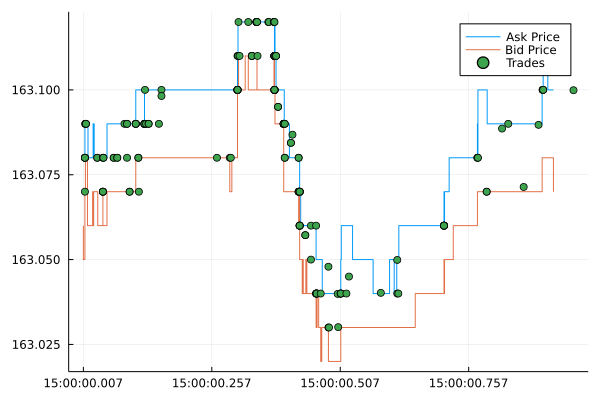
The trades line up nicely with the prices at the same time and we can see the series of trades that drove the price higher between 500 and 750 milliseconds past 15:00.
We’ve now got quite a complete picture of what happened in the second between 15:00:00 and 15:00:01.
It’s now up to you to use that data how you see fit. Here I’ll demonstrate a few ideas.
There are so many stock trading venues in the US, but what ones are good? If you’ve read Flash Boys, you might think they are all bad except for IEX. If you’ve read The Lean Startup you might think that the Long Term Stock Exchange is a good idea. But marketing and popularity aside, this is a key question for people that are fine-tuning their execution to ensure the best possible price.
But generally, we want to consider two things:
So using our quote data we can try and calculate some statistics.
Let’s pull some Apple quotes over one hour now.
aaplVenue = AlpacaMarkets.get_stock_quotes("AAPL", DateTime("2022-01-27T15:00:00"), DateTime("2022-01-27T16:00:00"))
first(aaplVenue, 4)
4 rows × 10 columns (omitted printing of 2 columns)
| ap | as | ax | bp | bs | bx | c | t | |
|---|---|---|---|---|---|---|---|---|
| Float64 | Int64 | String | Float64 | Int64 | String | Any | String | |
| 1 | 163.08 | 2 | Q | 163.06 | 1 | P | R | 2022-01-27T15:00:00.007177Z |
| 2 | 163.08 | 2 | Q | 163.05 | 4 | Q | R | 2022-01-27T15:00:00.007566848Z |
| 3 | 163.08 | 2 | K | 163.05 | 4 | Q | R | 2022-01-27T15:00:00.010519578Z |
| 4 | 163.08 | 2 | K | 163.06 | 1 | Q | R | 2022-01-27T15:00:00.010547447Z |
Using the TimeDate package we can create an object with the correct resolution up to the nanosecond as reported by Alpaca Markets. We then calculate how long that price was the best bid or offer using diff.
function get_ns(x)
    getfield(x, :value)
end

aaplVenue = @transform(aaplVenue, :TimeStamp = convert_t_timestamp.(:t),
                                  :TimeStamp_nano = TimeDate.(string.(chop.(:t))));
aaplVenue = @transform(aaplVenue, :TimeDelta = [diff(:TimeStamp_nano); NaN])
aaplVenue = aaplVenue[1:(end-1), :]
aaplVenue = @transform(aaplVenue, :ns = get_ns.(:TimeDelta));
Now for each venue, plus bid and ask price, we group by the exchange and calculate the following:
This gives us three different values to assess the ‘quality’ of each venue.
gdata_bids = groupby(aaplVenue, :bx)
gdata_asks = groupby(aaplVenue, :ax)
venue_bids = @combine(gdata_bids, :n_best_bid = length(:c),
                                  :avg_size_bid = mean(:as),
                                  :avg_time_best_bid = mean(:ns) * 1e-9)
venue_asks = @combine(gdata_asks, :n_best_ask = length(:c),
                                  :avg_size_ask = mean(:as),
                                  :avg_time_best_ask = mean(:ns) * 1e-9)
rename!(venue_asks, ["venue", "n_best_ask", "avg_size_ask", "avg_time_best_ask"])
rename!(venue_bids, ["venue", "n_best_bid", "avg_size_bid", "avg_time_best_bid"])

venue = leftjoin(venue_bids, venue_asks, on = "venue")
venue = leftjoin(venue, rename!(AlpacaMarkets.STOCK_EXCHANGES, ["Name", "venue"]), on = "venue")

first(venue[!,["Name", "n_best_ask", "avg_size_ask", "avg_time_best_ask"]], 4)
4 rows × 4 columns
| Name | n_best_ask | avg_size_ask | avg_time_best_ask | |
|---|---|---|---|---|
| String? | Int64? | Float64? | Float64? | |
| 1 | NYSE American (AMEX) | 1536 | 1.83464 | 0.0107363 |
| 2 | NASDAQ OMX BX | 161 | 1.95652 | 0.0152946 |
| 3 | National Stock Exchange | 48 | 3.33333 | 0.00691273 |
| 4 | MIAX | 29431 | 1.26829 | 0.00747923 |
Plus all the values for the bid side too.
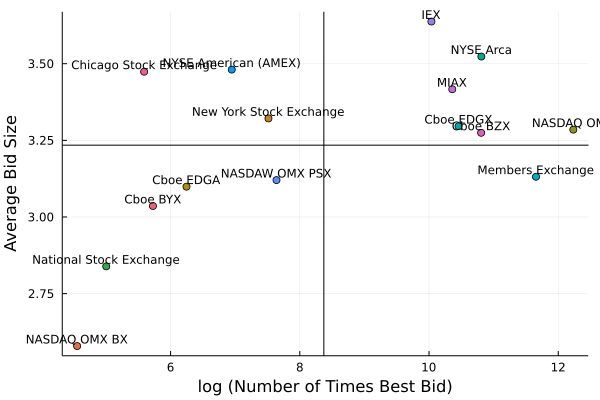
Now let’s visualise it with a quadrant plot.
plot(log.(venue.n_best_bid), venue.avg_size_bid, seriestype = :scatter,
    label = :none, group = venue.venue,
    series_annotations = text.(venue.Name, :bottom, pointsize=8),
    xlabel = "log (Number of Times Best Bid)",
    ylabel = "Average Bid Size")
hline!([mean(venue.avg_size_bid)], label=:none, color=:black)
vline!([mean(log.(venue.n_best_bid))], label=:none, color=:black)
plot(log.(venue.n_best_ask), venue.avg_time_best_ask, seriestype = :scatter,
    label = :none, group = venue.venue,
    series_annotations = text.(venue.Name, :bottom, pointsize=8),
    xlabel = "log (Number of Times Best Ask)",
    ylabel = "Average Time Best Ask (seconds)")
hline!([mean(venue.avg_time_best_ask)], label=:none, color=:black)
vline!([mean(log.(venue.n_best_ask))], label=:none, color=:black)
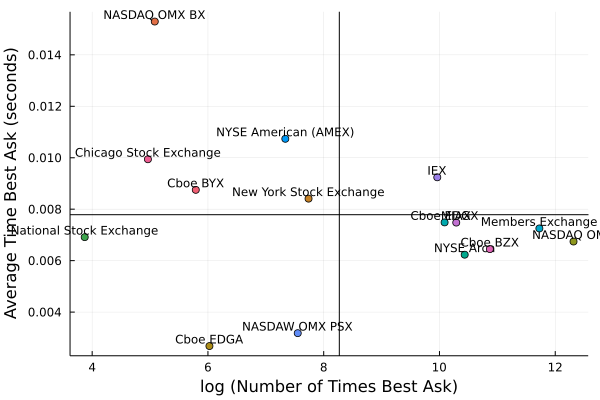
There are two clusters of exchanges and those to the right look like
the best. They are top of book the most and also quote the largest
size. To give an idea of size IEX quotes about 0.5 more shares than
the Members Exchange. For Apple with a share price of around $175,
you can trade $87.5 more notional with IEX (on average) than the
Members Exchange, so if you have a large order, it might mean going to
the market fewer times and therefore paying fewer transaction costs.
Ok so that’s something interesting with the quotes, what about the trades?
When Alpaca Markets sends us the trades there is no indication if the
trade was a buy or a sell. This can make analysis slightly harder as
we first have to try and guess the sign of the trade. If we look at
the plot of the trades again we can see that the trades happen
predicatably.
Most of the trades happen at the higher ask price, so they are
probably buying, and likewise, some trades fall on the bid price
line. These are probably sales.
Now guessing what sign the trades has plenty of academic research
behind it. One of the typical methods is the
Lee-Ready algorithm which
looks at where the trade is compared to the quoted mid-price at the time of the trade. If the trade is above the mid-price then it is likely that the trade was a buy and vice versa, if it was below it was likely a sell.
To evaluate this algorithm we have to join the trades with the closest prices. Normally this would just be an ASOF join, but we have to hack our way around this in Julia.
tradeTimes = aaplTrades.TimeStamp_nano
quoteTimes = aapl.TimeStamp_nano

quoteInds = searchsortedlast.([quoteTimes], tradeTimes)

aaplTrades[!, "ap"] = aapl.ap[quoteInds]
aaplTrades[!, "bp"] = aapl.bp[quoteInds]

aaplTrades = @transform(aaplTrades, :Mid = (:ap .+ :bp) ./ 2)

aaplTrades[1:4, ["t", "TimeStamp_nano", "p", "ap", "bp", "Mid"]]
4 rows × 6 columns (omitted printing of 2 columns)
| t | TimeStamp_nano | p | ap | |
|---|---|---|---|---|
| String | TimeDate | Float64 | Float64 | |
| 1 | 2022-01-27T15:00:00.010519578Z | 2022-01-27T15:00:00.010519578 | 163.07 | 163.08 |
| 2 | 2022-01-27T15:00:00.010519578Z | 2022-01-27T15:00:00.010519578 | 163.07 | 163.08 |
| 3 | 2022-01-27T15:00:00.010519578Z | 2022-01-27T15:00:00.010519578 | 163.08 | 163.08 |
| 4 | 2022-01-27T15:00:00.010519578Z | 2022-01-27T15:00:00.010519578 | 163.08 | 163.08 |
With the prices added we check the sign of the difference between the traded price and the mid-price to classify it as a buy or sell.
function classify_trade(x)
    if x == 0
        return "Unknown"
    elseif x == 1
        return "Buy"
    else
        return "Sell"
    end
end


aaplTrades = @transform(aaplTrades, :Sign = sign.(:p .- :Mid))
aaplTrades = @transform(aaplTrades, :Side = classify_trade.(:Sign))


plot(aapl.TimeStamp, aapl.ap, label = "Ask Price", seriestype=:steppre, xticks = (ticks, tick_labels))
plot!(aapl.TimeStamp, aapl.bp, label = "Bid Price", seriestype=:steppre)
plot!(aaplTrades.TimeStamp, aaplTrades.p, seriestype=:scatter, groups=aaplTrades.Side)
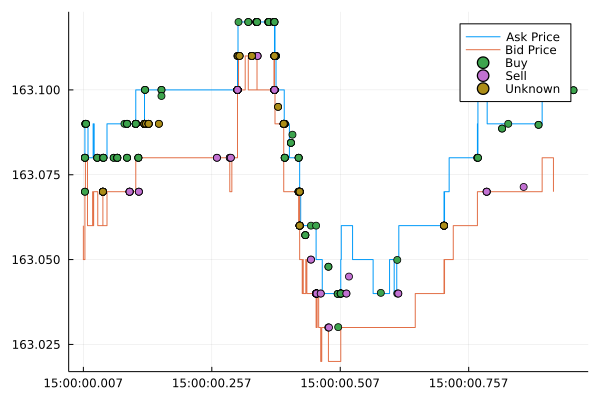
It’s not a 100% foolproof method, we can see that it hasn’t managed to
classify all the trades, some are unknown. It seems to struggle around
periods where the market starts moving and the mid is volatile. But there are other methods to keep digging deeper and classify all the trades.
Another angle of the free data world. Sign up to AlpacaMarkets today
and get your data to start exploring. Perhaps look at my older posts
where I’ve applied simple models to crypto data, you can change the
data to a stock and see how the results change.
Re-posted from: https://bkamins.github.io/julialang/2022/03/18/manning.html
One of the projects I am currently working on is writing the
Julia for Data Analysis book. In this post I want to give you a brief
overview of the contents of the book and its current status.
The book is aimed at data scientists with some programming experience wanting
to learn how to do data analysis in Julia. Some previous experience with Julia
would be a plus, but it is not strictly required.
Since the book is aimed as an entry-level introduction to data analysis in Julia
I have divided it into two parts:
I do not assume that you know the Julia language and in Part 1 explain the basic
components of the language from the very beginning. However, I assume that you
have some experience with programming (e.g. in R or Python).
Part 2 focuses on data analysis in Julia. In it I concentrate a lot on
the functionalities of the DataFrames.jl package.
It is impossible to cover every aspect of data analysis in Julia in a single
book. Therefore, my goal was to discuss all essential material that will
allow you to later confidently learn more advanced things on your own, while
being convenient that you have a firm grasp of the fundamental concepts.
Most of the chapters in the book are project oriented. I introduce new concepts
and functionalities of the Julia ecosystem by showing how they can be used to
solve practical problems.
Since the scope of the book is quite wide let me here list selected technical
topics that I discuss in it which, I think, are useful even for people who
already know Julia:
Notably, I have not covered in this book more advanced topics on machine
learning. The reason is that there are too many options available, so
this would be a material for another book. However, as I have already mentioned,
the book is written in a way so that after reading it you should be able to
easily learn the functionalities of the concrete packages that provide such
functionalities, like e.g. MLJ.jl, yourself.
For example, after reading this book you might want to check out my
Hands-on Data Science with Julia live project that gives you an
introduction to machine learning with Julia.
The book will be published by Manning. This week its first two chapters
have been made available in MEAP (Manning Early Access Platform).
You can find a preview of the book under this link.
If you are interested in the topic I encourage you to visit the website,
as MEAP program gives the readers an opportunity to give feedback about the
material I have prepared before the final version of the book is published.
All core chapters have been already written. Now we are going through a review
and publishing process. I will write another post when the book is finalized.
However, since all the technical material is already prepared, you can get the
source codes of all chapters from
GitHub.
Codes are shared there are under MIT license so you can freely reuse them.
Today, as a conclusion, let me pick one example code from the book (codes are
also available on GitHub).
The example code produces a plot that compares speed and code size of Julia,
Python, Java, and C on 10 standard problems taken from the
The Computer Language Benchmarks Game website.
The example is self-contained and was tested under Julia 1.7.0,
DataFrames.jl 1.3.2, CSV.jl 0.10.3, and Plots.jl 1.27.1.
data = """
problem,language,time,size
n-body,c,2.13,1633
mandelbrot,c,1.3,1135
spectral norm,c,0.41,1197
fannkuch-redux,c,7.58,910
fasta,c,0.78,1463
k-nucleotide,c,3.96,1506
binary-trees,c,1.58,809
reverse-complement,c,0.41,1965
pidigits,c,0.56,1090
regex-redux,c,0.8,1397
n-body,Java,6.77,1489
mandelbrot,Java,4.1,796
spectral norm,Java,1.55,756
fannkuch-redux,Java,10.48,1282
fasta,Java,1.2,2543
k-nucleotide,Java,4.83,1812
binary-trees,Java,2.51,835
reverse-complement,Java,1.57,2183
pidigits,Java,0.79,764
regex-redux,Java,5.34,929
n-body,Python,541.34,1196
mandelbrot,Python,177.35,688
spectral norm,Python,112.97,407
fannkuch-redux,Python,341.45,950
fasta,Python,36.9,1947
k-nucleotide,Python,46.31,1967
binary-trees,Python,44.7,660
reverse-complement,Python,6.62,814
pidigits,Python,1.16,567
regex-redux,Python,1.34,1403
n-body,Julia,4.21,1111
mandelbrot,Julia,1.42,619
spectral norm,Julia,1.11,429
fannkuch-redux,Julia,7.83,1067
fasta,Julia,1.13,1082
k-nucleotide,Julia,4.94,951
binary-trees,Julia,7.28,634
reverse-complement,Julia,1.44,522
pidigits,Julia,0.97,506
regex-redux,Julia,1.74,759
"""

using CSV
using DataFrames
using Plots

df = CSV.read(IOBuffer(data), DataFrame)

plot(map([:time, :size],
         ["execution time (relative to C)",
          "code size (relative to C)"]) do col, title
    df_plot = unstack(df, :problem, :language, col)
    df_plot[!, Not(:problem)] ./= df_plot.c
    select!(df_plot, Not(:c))
    scatter(df_plot.problem, Matrix(select(df_plot, Not(:problem)));
            labels=permutedims(names(df_plot, Not(:problem))),
            ylabel=title,
            yaxis = col == :time ? :log : :none,
            xrotation=20,
            markershape=[:rect :diamond :circle],
            markersize=[4 5 5],
            markercolor=[:lightgray :lightgray :gold],
            xtickfontsize=7, ytickfontsize=7,
            legendfontsize=7, ylabelfontsize=7)
            hline!([1.0]; color="orange", labels="C")
end...)
(the code is not easy, but after reading the whole book you should be able to
confidently read it and create a similar implementation yourself)
The figure produced by this code looks as follows.

If you would like to read a complete interpretation of the plot please check
Chapter 1 in Julia for Data Analysis book. Here let me just summarize
that Julia runs the code fast (left pane) and at the same time is convenient to
use (as measured by the code size; right pane).