By: Karl Pettersson
Re-posted from: https://www.dusty-test.klpn.se/posts/2016-11-06-secanc.html
Calculating lifetime cancer risk in a population
by Karl Pettersson.
Tags: epidemiology, julia
It is common to hear statements such as one in three persons will
,
develop cancer during their lifetimeone in nine women will develop
and so on. Most often, such statements are based on a
breast cancer
simple calculation of cumulative risk, i.e. age-specific incidence rates
for a given year and cancer diagnosis are summed up to a chosen maximum
age, e.g. 75 years, and the resulting cumulative incidence rate \(r\) is
then converted into a probability using the formula \(1-\exp(-r)\).
However, if lifetime cancer risk
is interpreted as the proportion of
the population which will be diagnosed with cancer during their
lifetime, this method gives incorrect results, because it does not take
the following into account:
- Future changes in cancer rates.
- People who die before they reach the maximum age, due to causes
unrelated to cancer. - People who develop cancer at ages above the maximum age.
- People who are diagnosed with multiple primary cancers during their
lifetime.
The first problem will not be further discussed in this post, as dealing
with it obviously would require projections into the future. The other
problems can be assessed with a method described by Sasieni et al. (2011), which
they call AMP (adjusted for multiple primaries
), and which only
requires routinely available data. Their idea is to build a life table
where it is possible to be eliminated from the population either by
being diagnosed with cancer or by dying from something other than
cancer. It is then possible to calculate the proportions eliminated in
these different ways. The AMP method hinges on the independence
assumption that primary cancer incidence and mortality from causes other
than cancer are the same among people who have had cancer as in the
general population, because these groups cannot normally be
differentiated in official statistics. Only the following data are
required:
- Age-specific population size, in order to calculate incidence and
mortality rates. - Age-specific number of cancer cases.
- Age-specific number of deaths due to all causes.
- Age-specific number of deaths due cancer. Note that official
statistics normally reports so-called underlying causes of deaths,
which means that this should include complications of cancer and
cancer treatment (otherwise, the independence assumption given above
would be violated).
Using my LifeTable package, the
AMP method can be easily implemented in Julia. I will give examples with
calculations for Sweden 2014, using data from Statistics Sweden (2016) for
population size, National Board of Health and Welfare (2015) for cancer cases and National Board of Health and Welfare (2025) for deaths.
The data are given in 5-year age intervals from 0–4 to 80–84 years,
with an open interval for ages above 85 years. The files used in the
example are available via a
gist.
The Julia
file
contains the following code:
using LifeTable, DataFrames

function AmpLt(inframe, sex, rate = "inc")
    age = inframe[1]
    pop = inframe[2]
    acd = inframe[3]
    cd = inframe[4]
    cc = inframe[5]
    if rate == "inc"
        ncol = cc
        dcol = acd .- cd .+ cc
    elseif rate == "mort"
        ncol = cd
        dcol = acd
    end
    df = DataFrame(age = age, pop = pop, dcol = dcol)
    cprop = ncol ./ dcol
    lt = PeriodLifeTable(df, sex)
    return CauseLife(lt, cprop)
end
Assuming the LifeTable package is installed and the files have been
downloaded, you can calculate tables with lifetime cancer risk for
Swedish females and males, at a given age:
include("amplt.jl")
fse14 = readtable("fse14.csv")
mse14 = readtable("mse14.csv")
ampfse14 = AmpLt(fse14, 2)
ampmse14 = AmpLt(mse14, 1)
The first row in the f column in a frame returned by AmpLt gives the
lifetime cancer risk at birth, which should be about 45.7 percent for
females and 49.3 percent for males. It is also possible to calculate
lifetime risk for cancer mortality, rather than incidence:
The first row in these frames should be about 22.3 and 26.2 percent for
females and males. With PyPlot, the frames can be plotted:
plot(ampfse14[:age], ampfse14[:f], label = "incidence, females")
plot(ampfse14[:age], ampmse14[:f], label = "incidence, males")
plot(ampfse14[:age], mampfse14[:f], label = "mortality, females")
plot(ampfse14[:age], mampmse14[:f], label = "mortality, males")
title("Lifetime cancer risk Sweden 2014")
xlim(0, 85)
ylim(0, 0.5)
legend(loc=3)
grid(1)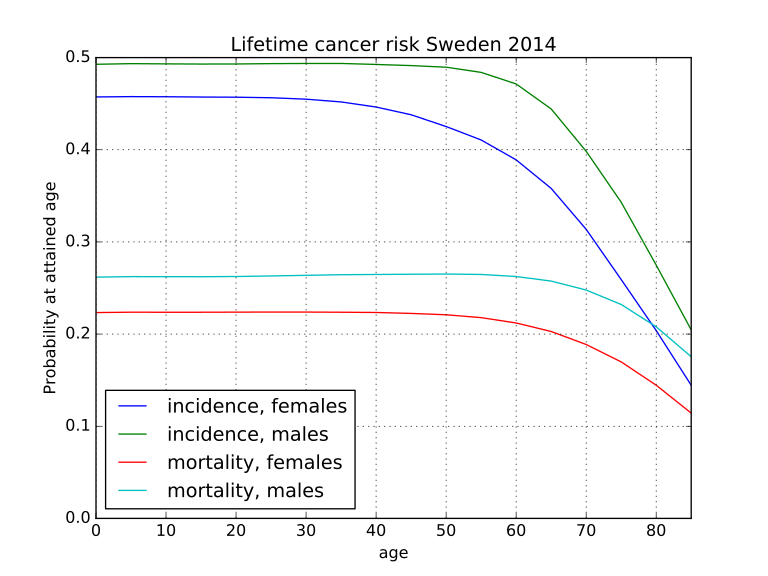
As the chart shows, the probabilities tend to decrease with age,
especially after age 60, which is due to increasing competition from
other causes of death, e.g. circulatory disorders.
If cancer incidence and mortality are changed, this might also influence
mortality from some non-cancer causes. For example, decreased smoking
tends to decrease lung cancer incidence and mortality, as well as
mortality from nonmalignant respiratory diseases and atherosclerotic
diseases.1 One might ask how such risk factor changes would influence
lifetime cancer risk, which might be decreased, as well as unchanged, or
even increased, due to diminished competition. The following function
recalculate a frame with cancer cases, as well as cancer deaths and
non-cancer deaths, changed by the same factor for all age groups:
function RateChange(inframe, changefac)
    ncd = inframe[4] .* changefac
    ncc = inframe[5] .* changefac
    nacd = (inframe[3].-inframe[4]).*changefac .+ ncd
    return DataFrame(age = inframe[1], pop = inframe[2],
        acd = nacd, cd = ncd, cc = ncc)
end
To calculate lifetime cancer risk for Swedish females with all three
rates reduced by one third, give AmpLt(RateChange(fse14, 2/3), 2). The
frame returned by this call gives a lifetime risk at birth of 37.5
percent. For males, the corresponding risk is 42.6 percent. For
mortality, the risks would be 19.2 and 24.0 percent for females and
males respectively. If age-specific cancer incidence and mortality and
non-cancer mortality are reduced by the same factor, in a society such
as Sweden, which already has high life expectancy, this tends to reduce
the lifetime risk of getting cancer or dying from it, because more
people will survive to higher ages where the probability of getting
cancer before succumbing to something else is lower (with greater
reductions, the risks at lower ages asymptotically approach the
corresponding risks at the highest age, i.e. 85 years in this example).
References
-
This shared risk factor can be expected to violate the
independence assumption in the AMP method to some extent. However,
as noted by Sasieni et al. (2011), these effects should not be serious when all
cancers are studied, because there are few lung cancer survivors in
the population.↩︎