Author Archives: Karl Pettersson

Life expectancy and transition in cause of death patterns

By: Karl Pettersson

Re-posted from: https://www.dusty-test.klpn.se/posts/2022-03-27-transition.html

Life expectancy and transition in cause of death patterns

Posted on 2022-03-27

by Karl Pettersson.

Tags: ,

This week, the Swedish statistical agency has published life tables for
Sweden 2021 (Statistics Sweden 2023). With the first waves of the COVID pandemic, life
expectancy at birth decreased from 84.73 years for females and 81.34
years for males in 2019 to 84.29/80.60 years in 2020. For 2021, the
numbers were again 84.82/81.21 years. This reflects, of course, the
decreased COVID mortality due to vaccination. Moreover, the flu A(H3N2)
wave, which peaked around Christmas with rather high rates of illness
among young people, did not cause substantial excess mortality, which
may, in part, be due to people with respiratory symptoms having less
contacts than usual with older people and other risk groups.

The increase in life expectancy in Sweden, and many other countries, up
until the mid-20th century was largely driven by decreasing childhood
mortality, which also caused changes in the cause of death patterns,
with directly communicable diseases becoming less common relative to
age-related diseases, such as circulatory diseases and cancer. In
contrast, the continued increase in rich countries after that, which was
temporarily interrupted by the pandemic, is largely due to decreased
mortality at older ages.

Vishnevsky (2017) discusses the development in life expectancy and causes
of death after 1960 in Russia, compared to high-income countries, in
particular Western European countries. In the EU-15 countries,
age-standardised mortality rates from circulatory, external and
respiratory causes have decreased greatly since 1970, while cancer
mortality has decreased modestly. The proportion of deaths from
circulatory causes has also decreased (from nearly 50 percent to about
30 percent), while the proportion of deaths from cancer has increased
(from about 20 percent to about 30 percent). No such changes have
occurred in Russia, where life expectancy has not improved much since
the 1960s (although it has improved relative to the dramatic increases
in mortality during the 1990s).

From this, one might conclude that the increased life expectancy in rich
countries largely has been about decreased circulatory mortality.
However, Vishnevsky points out that focusing on standardised rates for
all ages hides a significant increase in life expectancy for those dying
also of non-circulatory causes. In Sweden, for example, the life
expectancy for people dying of cancer or other neoplasms increased 8.2
years for females and 7.6 years for males during to period 1960–2010.
The corresponding increase for circulatory diseases (where life
expectancy was higher than for cancer already in 1960) is 8.0/6.8 years.
It is clear that this reflects a marked decrease in cancer mortality at
young ages, a point similar to what has been made earlier by researchers
like Riggs (1994).

One factor not discussed by Vishnevsky is the impact of changing
practices in reporting causes of death over a long time. For example,
the increase in life expectancy has been particularly strong for the
residual category, other diseases, in Sweden, with 20.0 years for
females and 17.8 years for males. This category includes dementia, which
was a rare underlying cause of death in 1960. Back then, most people
with dementia probably had circulatory or respiratory causes reported
instead, and the other category was dominated by other causes, with a
much lower life expectancy.

In light of this, it may be interesting to compare the correlation
between general life expectancy and proportion of deaths ascribed to
different causes in varying countries more in detail. I made a Julia
package, MortIntl, which can be
used to analyse such trends, based on cause-specific mortality data from
WHO (2025) and life tables from University of California, Berkeley and Max Planck Institute for Demographic Research (2022). It uses a configuration similar to
my earlier Mortchartgen,
which I have used to generate Mortality
Charts
, but extracts data directly from
the data files using AWK instead of relying on a SQL database.

Fig. 1 and fig. 2 show female and male life expectancy at birth in
relation to proportion of deaths from circulatory causes (as defined for
Mortality Charts) for
the Nordic and Baltic countries, with Iceland excluded due to small
population.1
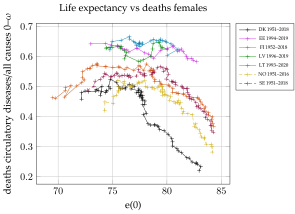
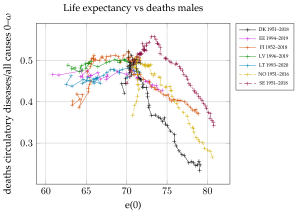
Figure 1: Circulatory deaths vs life expectancy females Nordic and Baltic countries.
Figure 2: Circulatory deaths vs life expectancy males Nordic and Baltic countries.

The charts clearly show that improvements in life expectancy continued
for a long time among, for example, females in Finland and Sweden, after
circulatory causes became dominant, without any substantial change in
the proportion of deaths ascribed to these causes. That proportion
really started decreasing after the 1980s, when dementia became more
commonly reported (see Mortality
Charts
).

The Baltic countries, especially Estonia, have in recent years attained
a female life expectancy close to the Nordic countries, but the
proportion of circulatory deaths there is higher than it has been in the
Nordic countries at any point in time. In contrast, Denmark, has had a
lower proportion of circulatory deaths than the other Nordic countries,
a pattern which has been more pronounced in recent decades. The
difference in circulatory deaths between Denmark and Estonia in recent
years, when both have had similar life expectancy among females, is
greater than the temporal variation, over nearly 70 years, in any of the
Nordic countries.

From this, it seems that clear that great caution is warranted in
drawing any epidemiological conclusions from trends for officially
reported circulatory mortality over all ages.

References

Riggs, J. E. 1994. “The cohort mortality perspective: The emperor′s new clothes of epidemiology, an illustration using cancer mortality.” Regulatory Toxicology and Pharmacology 19 (2): 202–210. doi:10.1006/rtph.1994.1018.
Statistics Sweden. 2023. “Life table by sex and age.” https://www.statistikdatabasen.scb.se/goto/en/ssd/LivslangdEttariga.
University of California, Berkeley and Max Planck Institute for Demographic Research. 2022. Human Mortality Database.” https://www.mortality.org.
Vishnevsky, Anatoly. 2017. “Mortality in russia: The second epidemiological revolution that never was.” Demographic Review 2 (5): 4–33. doi:10.17323/demreview.v2i5.5581.
WHO. 2025. “WHO Mortality Database.” https://www.who.int/data/data-collection-tools/who-mortality-database.

  1. The charts can be generated by cloning the blog
    repository
    , installing
    MortIntl with the relevant data files, as described in the
    documentation, and running circall_e0_baltnord.jl in the
    subdirectory postdata/2022-03-27-transition.↩︎

Life expectancy and transition in cause of death patterns

By: Karl Pettersson

Re-posted from: https://static-dust.klpn.se/posts/2022-03-27-transition.html

Life expectancy and transition in cause of death patterns

Posted on 2022-03-27

by Karl Pettersson.

Tags: epidemiology, julia

This week, the Swedish statistical agency has published life tables for
Sweden 2021 (Statistics Sweden 2022). With the first waves of the COVID pandemic, life
expectancy at birth decreased from 84.73 years for females and 81.34
years for males in 2019 to 84.29/80.60 years in 2020. For 2021, the
numbers were again 84.82/81.21 years. This reflects, of course, the
decreased COVID mortality due to vaccination. Moreover, the flu A(H3N2)
wave, which peaked around Christmas with rather high rates of illness
among young people, did not cause substantial excess mortality, which
may, in part, be due to people with respiratory symptoms having less
contacts than usual with older people and other risk groups.

The increase in life expectancy in Sweden, and many other countries, up
until the mid-20th century was largely driven by decreasing childhood
mortality, which also caused changes in the cause of death patterns,
with directly communicable diseases becoming less common relative to
age-related diseases, such as circulatory diseases and cancer. In
contrast, the continued increase in rich countries after that, which was
temporarily interrupted by the pandemic, is largely due to decreased
mortality at older ages.

Vishnevsky (2017) discusses the development in life expectancy and causes
of death after 1960 in Russia, compared to high-income countries, in
particular Western European countries. In the EU-15 countries,
age-standardised mortality rates from circulatory, external and
respiratory causes have decreased greatly since 1970, while cancer
mortality has decreased modestly. The proportion of deaths from
circulatory causes has also decreased (from nearly 50 percent to about
30 percent), while the proportion of deaths from cancer has increased
(from about 20 percent to about 30 percent). No such changes have
occurred in Russia, where life expectancy has not improved much since
the 1960s (although it has improved relative to the dramatic increases
in mortality during the 1990s).

From this, one might conclude that the increased life expectancy in rich
countries largely has been about decreased circulatory mortality.
However, Vishnevsky points out that focusing on standardised rates for
all ages hides a significant increase in life expectancy for those dying
also of non-circulatory causes. In Sweden, for example, the life
expectancy for people dying of cancer or other neoplasms increased 8.2
years for females and 7.6 years for males during to period 1960–2010.
The corresponding increase for circulatory diseases (where life
expectancy was higher than for cancer already in 1960) is 8.0/6.8 years.
It is clear that this reflects a marked decrease in cancer mortality at
young ages, a point similar to what has been made earlier by researchers
like Riggs (1994).

One factor not discussed by Vishnevsky is the impact of changing
practices in reporting causes of death over a long time. For example,
the increase in life expectancy has been particularly strong for the
residual category, other diseases, in Sweden, with 20.0 years for
females and 17.8 years for males. This category includes dementia, which
was a rare underlying cause of death in 1960. Back then, most people
with dementia probably had circulatory or respiratory causes reported
instead, and the other category was dominated by other causes, with a
much lower life expectancy.

In light of this, it may be interesting to compare the correlation
between general life expectancy and proportion of deaths ascribed to
different causes in varying countries more in detail. I made a Julia
package, MortIntl, which can be
used to analyse such trends, based on cause-specific mortality data from
WHO (2022) and life tables from University of California, Berkeley and Max Planck Institute for Demographic Research (2022). It uses a configuration similar to
my earlier Mortchartgen,
which I have used to generate Mortality
Charts
, but extracts data directly from
the data files using AWK instead of relying on a SQL database.

Fig. 1 and fig. 2 show female and male life expectancy at birth in
relation to proportion of deaths from circulatory causes (as defined for
Mortality Charts) for
the Nordic and Baltic countries, with Iceland excluded due to small
population.1

Figure 1: Circulatory deaths vs life expectancy females Nordic and Baltic countries.
Figure 2: Circulatory deaths vs life expectancy males Nordic and Baltic countries.

The charts clearly show that improvements in life expectancy continued
for a long time among, for example, females in Finland and Sweden, after
circulatory causes became dominant, without any substantial change in
the proportion of deaths ascribed to these causes. That proportion
really started decreasing after the 1980s, when dementia became more
commonly reported (see Mortality
Charts
).

The Baltic countries, especially Estonia, have in recent years attained
a female life expectancy close to the Nordic countries, but the
proportion of circulatory deaths there is higher than it has been in the
Nordic countries at any point in time. In contrast, Denmark, has had a
lower proportion of circulatory deaths than the other Nordic countries,
a pattern which has been more pronounced in recent decades. The
difference in circulatory deaths between Denmark and Estonia in recent
years, when both have had similar life expectancy among females, is
greater than the temporal variation, over nearly 70 years, in any of the
Nordic countries.

From this, it seems that clear that great caution is warranted in
drawing any epidemiological conclusions from trends for officially
reported circulatory mortality over all ages.

References

Riggs, J. E. 1994. “The cohort mortality perspective: The emperor′s new clothes of epidemiology, an illustration using cancer mortality.” Regulatory Toxicology and Pharmacology 19 (2): 202–210. doi:10.1006/rtph.1994.1018.
Statistics Sweden. 2022. “Life table by sex and age.” https://www.statistikdatabasen.scb.se/goto/en/ssd/LivslangdEttariga.
University of California, Berkeley and Max Planck Institute for Demographic Research. 2022. “Coronavirus (COVID-19) infection survey, UK: 7 january 2022.” https://www.mortality.org.
Vishnevsky, Anatoly. 2017. “Mortality in russia: The second epidemiological revolution that never was.” Demographic Review 2 (5): 4–33. doi:10.17323/demreview.v2i5.5581.
WHO. 2022. “WHO Mortality Database.” https://www.who.int/data/data-collection-tools/who-mortality-database.

  1. The charts can be generated by cloning the blog
    repository
    , installing
    MortIntl with the relevant data files, as described in the
    documentation, and running circall_e0_baltnord.jl in the
    subdirectory postdata/2022-03-27-transition.↩︎

A website with mortality charts built using Julia

By: Karl Pettersson

Re-posted from: http://static-dust.klpn.se/posts/2017-03-01-mcsite.html

A website with mortality charts built using Julia

Posted on 2017-03-01

by Karl Pettersson.

Tags: epidemiology, julia

Since 2015, I have run a website with cause-specific mortality trends. The idea is to have a static site, which gives fast and easy access to information about international mortality trends, using open data available from WHO (2016), which, for many countries, covers the time period from 1950 up until recent times. The website is inspired by Whitlock (2012), which contains comprehensible charts with mortality trends based on these data, but has been unmaintained since 2013, when its creator died. Other sites with international cause-specific mortality trends I have seen tend to be slower, due to dynamic chart generation, and to cover only shorter time periods.

My implementation of the site generator, which was written in Python and R, had become rather messy, and the chart tools I used (matplotlib and ggplot2) are not really suited to make interactive web charts. I decided to rewrite the routines to generate the charts and the site files in Julia (albeit with the help of some non-Julia tools, as described below). These routines are now available as a GitHub repo, and I use them to generate the site in both English and Swedish versions.

The site is built as follows with the Julia package (see the README in the repo for instructions). The whole process is controlled with a JSON configuration file. YAML, using some non-JSON features, might be less cumbersome, and will perhaps be used once there is full YAML write support implemented in Julia. Julia functions mentioned are in the main Mortchartgen.jl file, if not otherwise stated.

  1. The WHO (2016) data files are downloaded and read into a MySQL database, using the functions in the Download.jl file.
  2. These data files contain cause of death codes from many different versions of the ICD classifications for different time periods and countries, and the codes are also often at a much more detailed level than I use in the charts. Therefore, the data on deaths is grouped using regular expressions defined in the configuration file. To avoid repeating this time-consuming regular expression matching, the resulting DataFrames can be saved in CSV files. There are still some issues with unsupported datatypes in the MySQL.jl package, which mean that grouping cannot be done at the SQL level and that prepared SQL statements cannot be used.
  3. The charts themselves are generated from the DataFrames created in step 2, using the Python Bokeh library, which is well-suited for interactive web visualizations. I call Bokeh directly using PyCall, instead of using the Bokeh.jl package, which is unmaintained. There is a batchplot function to generate all the charts for the site using the settings in the configuration file.
  4. The writeplotsite function generates the charts as well as HTML tables with links to the charts, a documentation file in Markdown format, and navigation menus for a given language, and copies these to a given output location. To generate the site files, except for the charts themselves, templates processed with Mustache.jl are used.
  5. The final generation of the site is done using Hakyll, a static site generator written in Haskell. In the output directory generated in step 4, there will be a Haskell source file, site.hs, which, provided that a Haskell complier and the Hakyll libraries are installed, can be compiled to an executable file. This file can then be run as ./site build to generate the site, which can then be uploaded to a web server. The resulting site is static in the sense that it has no code running on the server-side (but rendering the charts requires JavaScript on the client side).

References

Whitlock, Gary. 2012. “Mortality Trends [archived 21 december 2014].” http://web.archive.org/web/20141221203103/http://www.mortality-trends.org/.

WHO. 2016. “WHO Mortality Database.” http://www.who.int/healthinfo/mortality_data/en/index.html.