We wanted to thank all Julia users and well wishers for the continued use of and support for Julia, and share some of the latest developments from Julia Computing and the Julia community.
- Julia Computing Selected for RiskTech100 Rising Star Award
- NVIDIA: High-Performance GPU Computing in the Julia Programming Language
- Path BioAnalytics and Julia Computing Research Collaboration
- Upcoming Events Featuring Julia
- Recent Events Featuring Julia
- Recent Blog Posts in the Julia Community
- Contact Us
-
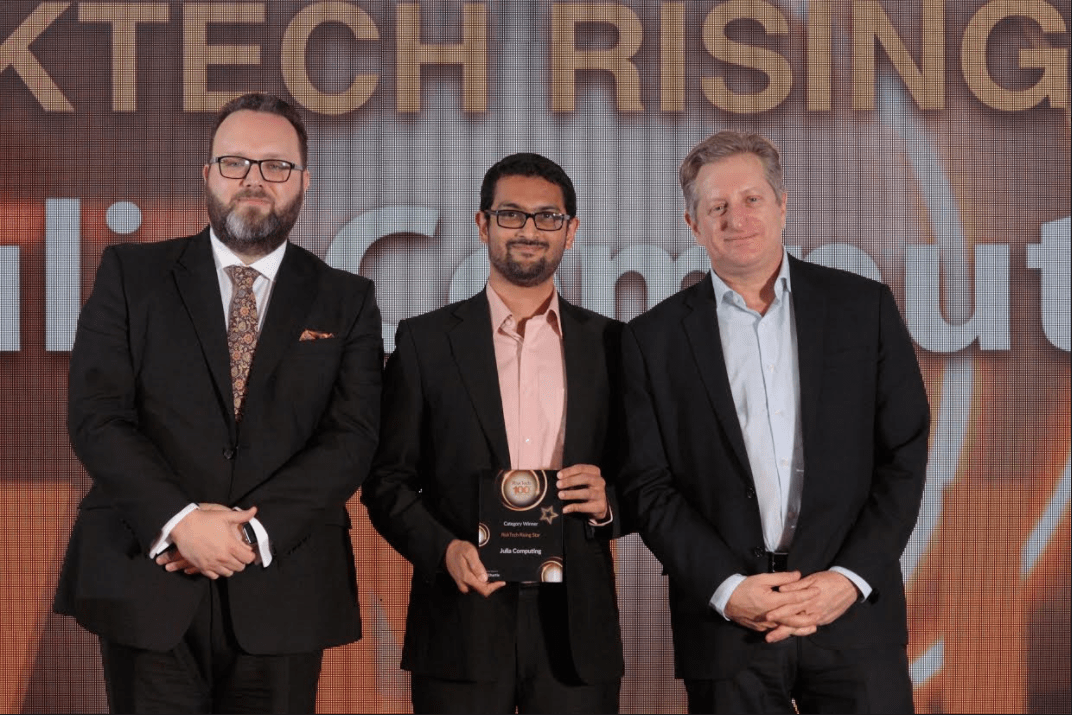
Julia Computing Selected for RiskTech100 2018 Rising Star Award: Julia Computing was honored to be selected for the RiskTech100 2018 Rising Star Award.

Julia Computing CEO Viral Shah (center) accepts RiskTech100 2018 Rising Star Award from Chartis Research Head of Research Rob Stubbs (left) and Neuberger Berman Senior Portfolio Manager Steve Eisman (right) -
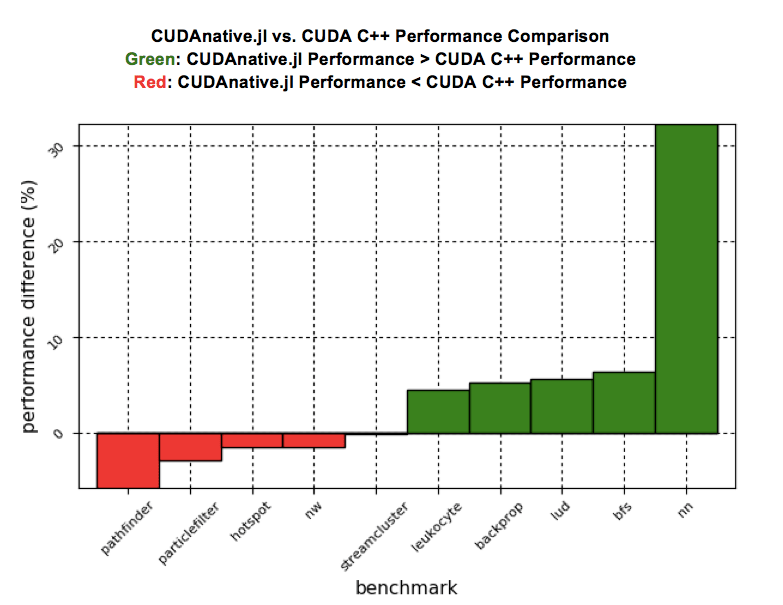
NVIDIA: High Performance GPU Computing in the Julia Programming Language by Julia developer Tim Besard – Oct 25, 2017
The chart below compares CUDAnative.jl performance with CUDA C++ for 10 benchmarks. CUDAnative.jl provides a 30%+ performance improvement compared with CUDA C++ for the nn benchmark and is comparable (+/- 7%) for the other nine benchmarks tested.

-
Path BioAnalytics and Julia Computing Research Collaboration: Path BioAnalytics and Julia Computing entered into a research collaboration to advance precision medicine and drug development for cystic fibrosis.
-
Upcoming Events Featuring Julia: Do you know of any upcoming conferences, meetups, trainings, hackathons, talks, presentations or workshops involving Julia? Would you like to organize a Julia event on your own, or in partnership with your company, university or other organization? Let us help you spread the word and support your event by sending us an email with details. Here are a few upcoming events:
- London: Quant Insights Conference Nov 7-10
- Bangalore: Julia Computing Workshop at IoTNext Nov 9
- Denver: Intel HPC DevCon Nov 11-12
- Denver: Supercomputing SC17 Nov 12-17 (Find us in the Intel booth)
- Johannesburg: Hello Julia Nov 14
- Warsaw: Using JuMP to Optimize the Location of Medical Accelerators Nov 16
- Sydney: Numerical Computing with Functions in Julia Nov 16
- Copenhagen: Machine Learning in Julia Nov 20
- New York: PyData Nov 27-30 and Diversity & Inclusion in Scientific Computing (DISC) Unconference Nov 29-30
-
Recent Events Featuring Julia: Do you want to share photos, videos or details of your most recent conference, meetup, training, hackathon, talk, presentation or workshop involving Julia? Please send us an email with details and links.
Recent highlights include:
-
Grace Hopper Celebration of Women in Computing. Jane Herriman, Director of Diversity and Outreach, represented Julia Computing at the Grace Hopper Celebration of Women in Computing in Orlando, FL October 4-6. Details are available here.
-
Alan Turing Institute. Julia Computing’s Mike Innes and UCL’s Pontus Stenetorp presented “Best Practice from Julia: Impact through Efficient Research Code at the British Library on October 24. Details and a link to the video is available here.
-
Julia Computing Presents Celeste at the US Library of Congress. The Planetary Society invited Julia Computing to present the Celeste project at the US Library of Congress in Washington DC on October 25. Details are available here.
Other recent Julia events include:
- San Francisco: Partially Observable Markov Decision Processes in Julia Oct 12
- Copenhagen: Let’s Talk Julia! Oct 12
- London: Open Data Science Conference Oct 12-14
- Taiwan: Julia Taiwan Meetup Oct 14
- London: Machine Learning: The Julian Approach Oct 16
- Boston: Hacktoberfest Oct 17
- San Jose: LLVM Developers’ Meeting Oct 17-19
- Sydney: Introduction to Julia Oct 19
- Copenhagen: Julia: High Performance Dynamic Language for Numeric Computing Oct 26
- San Francisco: Open Data Science Conference Nov 2-4
- Berlin: Automated Drawing of Transit Maps with Julia/JuMP Nov 7
-
-
Recent Blog Posts in the Julia Community:
-
Writing Extendable and Hardware Agnostic GPU Libraries by Simon Danisch – Nov 6, 2017
“I hope this blog post illustrates how nice it can be to write GPU code using Julia!” -
Drawing 2.7 Billion Points in 10 Seconds by Simon Danisch – Oct 31, 2017
“Since I’ve been very happy at how quickly I was able to create a very fast solution [using Julia], I decided to share my experience!” -
DifferentialEquations.jl 3.0 and a Roadmap for 4.0 by Christopher Rackauckas – Oct 30, 2017
“The 30 people who make up the JuliaDiffEq team have really built a software which has the methods to solve most differential equations that users encounter and also do so efficiently.” -
Defining Custom Units in Julia and Python by Erik Engheim – Oct 29, 2017
“This is an interesting case for Julia because it shows quite clearly the advantages of using a language supporting multiple dispatch in comparison to a more traditional object-oriented language such as Python, which relies on single dispatch.” -
I Like Julia Because It Scales and Is Productive – Insights from a Julia Developer by Christopher Rackauckas – Oct 13, 2017
“Julia is not only a fast language, but what makes it unique is how predictable the performance and the compilation process is.” -
Non-Linear Regression in Julia by Julio Cardenas-Rodriguez – June 14, 2017
“[F]or a simple processing task of calculating a T1 map of a lemon, Julia is 10 times faster than Python and ~635 times faster than Matlab.”
-
-
Contact Us: Please contact us if you wish to:
- Purchase or obtain license information for Julia products such as JuliaPro, JuliaRun, JuliaDB, JuliaFin or JuliaBox
- Obtain pricing for Julia consulting projects for your enterprise
- Schedule Julia training for your organization
- Share information about exciting new Julia case studies or use cases
- Partner with Julia Computing to organize a Julia meetup group, hackathon, workshop, training or other event in your city
About Julia and Julia Computing
Julia is the fastest high performance open source computing language for data, analytics, algorithmic trading, machine learning, artificial intelligence, and many other domains. Julia solves the two language problem by combining the ease of use of Python and R with the speed of C++. Julia provides parallel computing capabilities out of the box and unlimited scalability with minimal effort. For example, Julia has run at petascale on 650,000 cores with 1.3 million threads to analyze over 56 terabytes of data using Cori, the world’s sixth-largest supercomputer. With more than 1.2 million downloads and +161% annual growth, Julia is one of the top programming languages developed on GitHub. Julia adoption is growing rapidly in finance, insurance, machine learning, energy, robotics, genomics, aerospace, medicine and many other fields.
Julia Computing was founded in 2015 by all the creators of Julia to develop products and provide professional services to businesses and researchers using Julia. Julia Computing offers the following products:
- JuliaPro for data science professionals and researchers to install and run Julia with more than one hundred carefully curated popular Julia packages on a laptop or desktop computer.
- JuliaRun for deploying Julia at scale on dozens, hundreds or thousands of nodes in the public or private cloud, including AWS and Microsoft Azure.
- JuliaFin for financial modeling, algorithmic trading and risk analysis including Bloomberg and Excel integration, Miletus for designing and executing trading strategies and advanced time-series analytics.
- JuliaDB for in-database in-memory analytics and advanced time-series analysis.
- JuliaBox for students or new Julia users to experience Julia in a Jupyter notebook right from a Web browser with no download or installation required.
To learn more about how Julia users deploy these products to solve problems using Julia, please visit the Case Studies section on the Julia Computing Website.
Julia users, partners and employers hiring Julia programmers in 2017 include Amazon, Apple, BlackRock, Capital One, Citibank, Comcast, Disney, Facebook, Ford, Google, IBM, Intel, KPMG, Microsoft, NASA, Oracle, PwC, Uber, and many more.